
Mesh or Voxels: Level of Detail with DMesh++
MIT Summer Geometry Initiative (SGI 2025), mentored by Yi Zhou of Adobe Research
In July 2025, during the MIT Summer Geometry Initiative, I spent two weeks with Dr. Yi Zhou of Adobe Research, working alongside fellow Amruth Srivathsan. The project built on DMesh++, a differentiable mesh pipeline by Son et al.
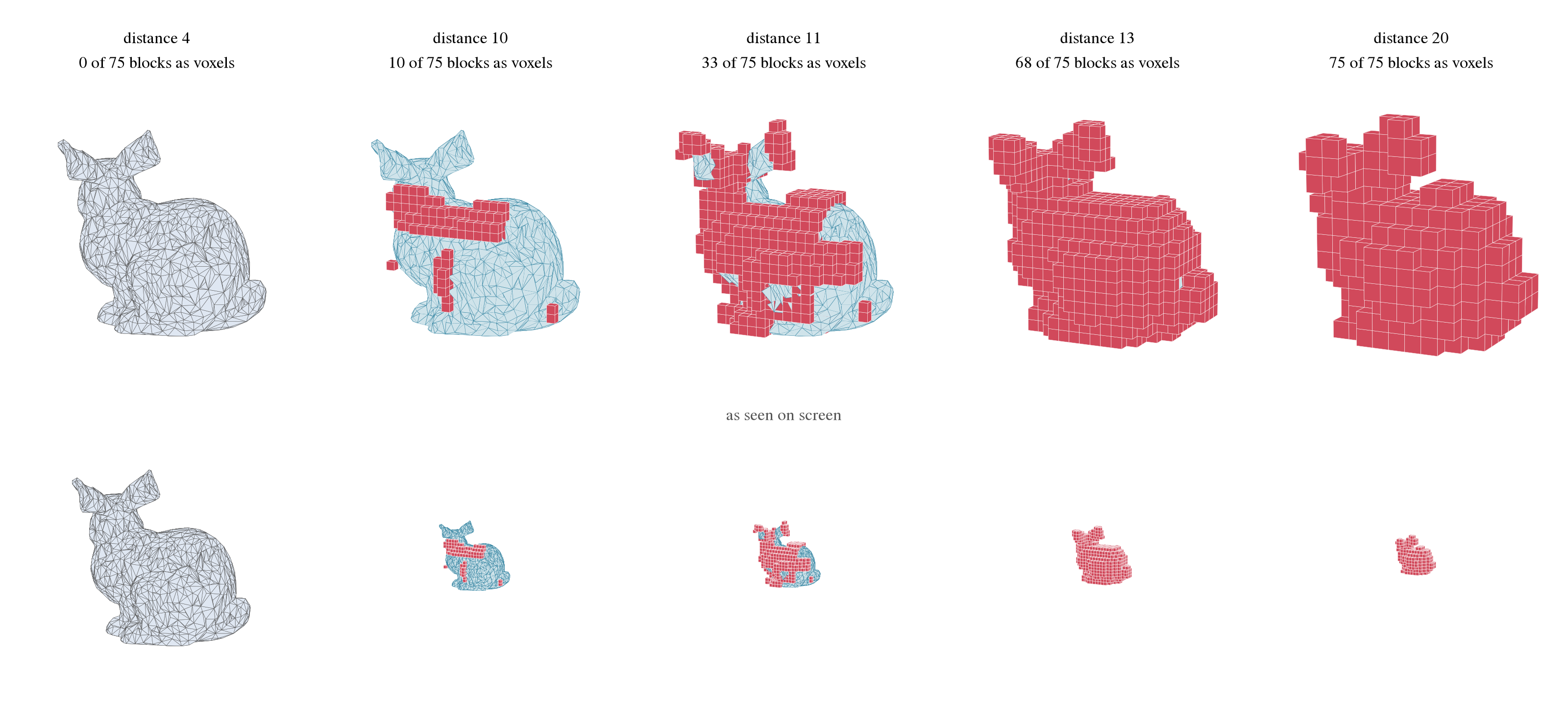
The bunny moving away from the camera. Close up it stays the original mesh; farther away the voxels can be bigger, and more and more of it switches to voxels. Bottom: the same, at the size it takes on screen.
Problem
Game engines like Unreal Engine swap an object for simpler versions as it moves away from the camera. This is not about close-ups: up close the original mesh is what you want. Far away, its small triangles end up smaller than a pixel and stop adding anything.
The usual far versions are a lower-resolution mesh or a billboard, a flat picture that faces the camera. A low-resolution mesh loses thin parts like ears first, and a billboard has no depth, so it breaks when the view or the light changes. Voxels keep the volume: they still block light, cast and receive shadows, hide what is behind them and move with the object. So, taking the DMesh++ pipeline as given, the goal was a level of detail that hands the far parts of a mesh over to voxels, block by block, with a rule that gradients can follow instead of hand-tuned switches.
How it works
DMesh++ gives every candidate triangle a probability instead of an on/off value, so the mesh connectivity can change smoothly during optimization. On top of that:
- Distance: a voxel covers about four pixels on screen, so the farther the object, the bigger a voxel can be.
- Mesh or voxel: split the Stanford bunny into blocks, and switch a block to voxels once its triangles are smaller than a voxel. Close up nothing changes; far away the whole bunny is voxels.
- Pixel to voxel: match one column of voxels to each pixel of a silhouette, and fit the voxels by gradient descent.
- Silhouettes: compare the outline of each version against the full scan from eight angles.
Results
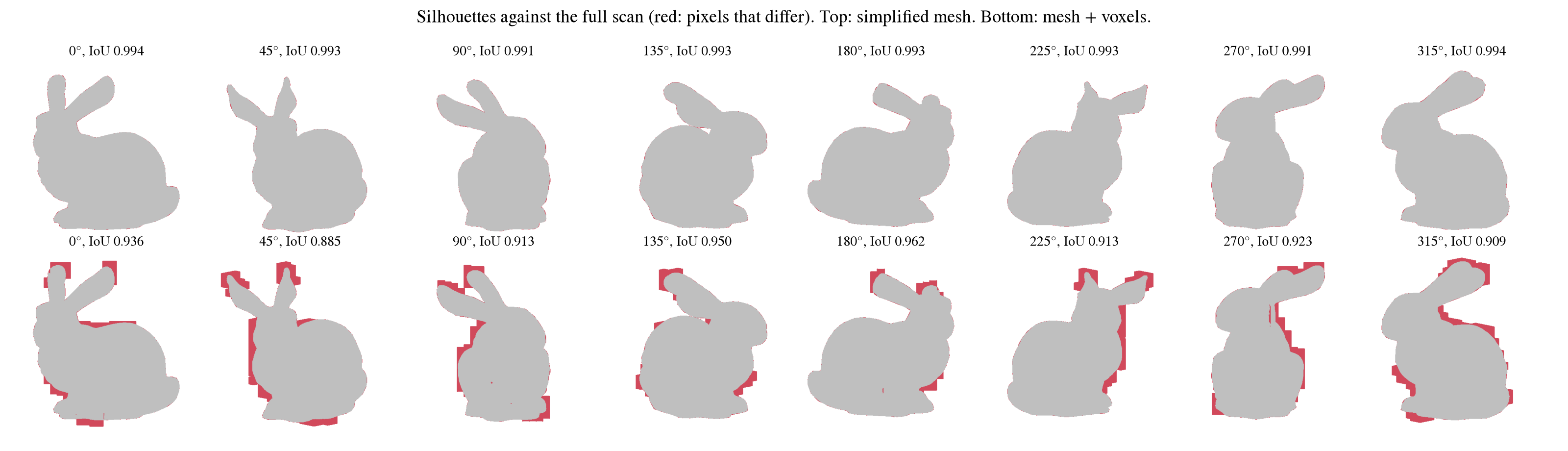
Silhouettes from eight angles against the full scan at distance 10, drawn at full size, with the pixels that differ in red. Top: simplified mesh. Bottom: mesh + voxels.
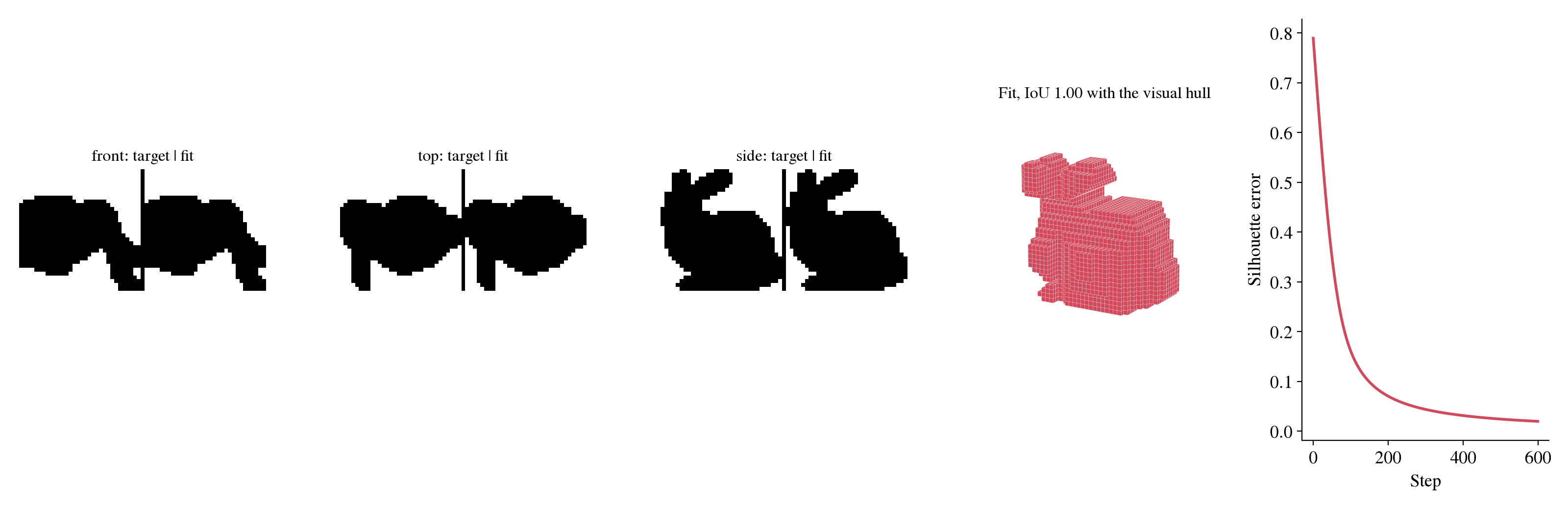
One voxel column per pixel: a voxel grid fitted to three silhouettes by gradient descent recovers their visual hull.
| 4 → 20 Went from all mesh to all voxels as the bunny moved away, 0 to 75 of 75 blocks. |
| 69,451 → 3,000 Simplified the Stanford bunny, keeping small triangles only where the detail is. |
| 0.99 vs 0.92 Measured what the voxels cost the outline at distance 10, mesh alone vs with voxels, seen at full size. |
| 1.00 Matched the visual hull of three silhouettes with the pixel-to-voxel fit. |
Blog
As an extra, we wrote a blog post for SGI that explains how DMesh++ works, with an interactive playground for its Minimum-Ball test. The post is linked from the DMesh++ project page. We thank Yi Zhou for mentoring us and Sanghyun Son, first author of DMesh and DMesh++, for sharing his insights.