
Local Intrinsic Dimensionality of Real and AI-Generated Images
MIT Summer Geometry Initiative (SGI 2025), mentored by Ankita Shukla of the University of Nevada, Reno
In August 2025, during the MIT Summer Geometry Initiative, I spent two weeks with Professor Ankita Shukla of the University of Nevada, Reno. The project explored the geometry and topology of AI-generated images.
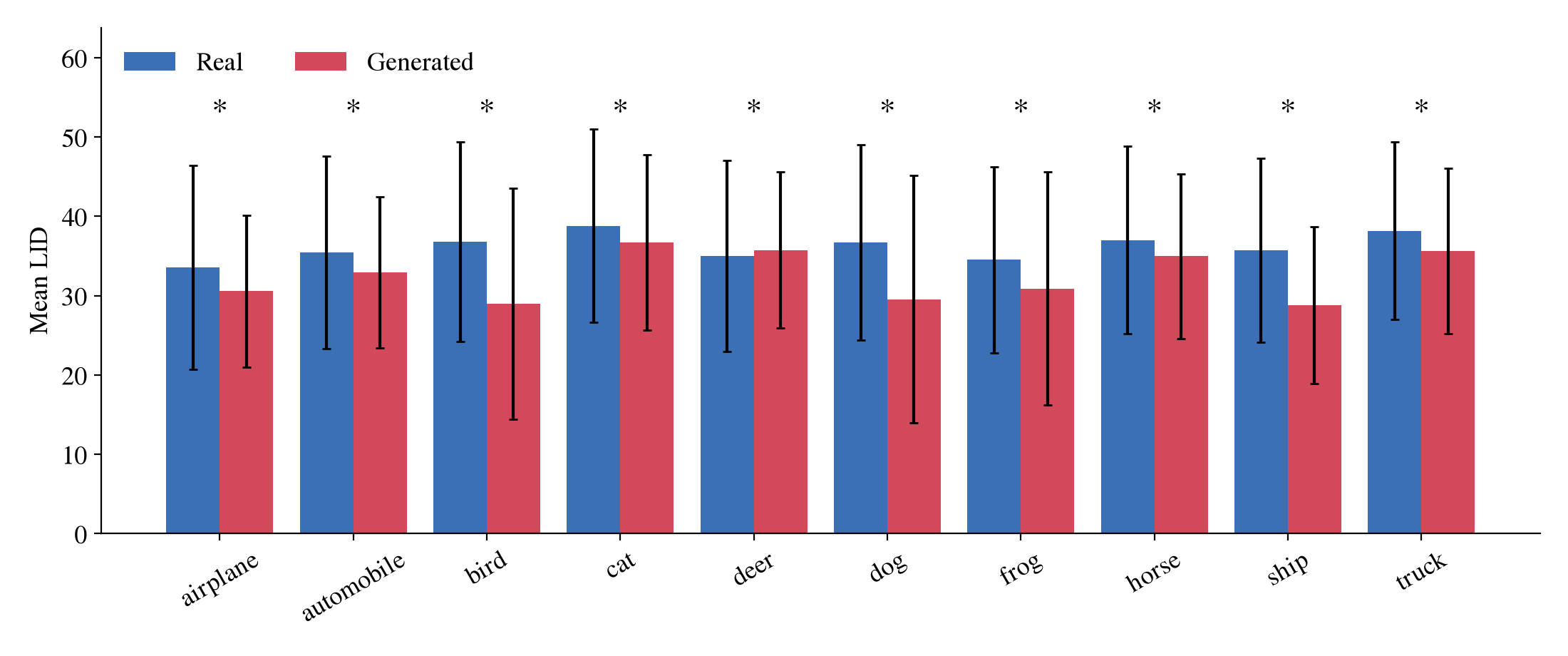
Mean LID for each CIFAR-10 class, with standard deviations: real images sit higher than generated ones in every class except deer.
Problem
Generated images are getting hard to tell apart from real ones. Instead of looking at the pixels, we looked at where each image lands inside a neural network’s feature space, where real and generated images might be spread out differently. So the goal was to test if a single geometric measure could tell them apart.
How it works
My hypothesis was that real images sit in richer neighbourhoods than generated ones. To test it:
- Features: 100,000 CIFAR-10-sized images, half real and half generated, passed through a ResNet-18.
- LID: for each image, local intrinsic dimensionality estimates how many directions the data really spreads in around it, from the distances to its nearest neighbours.
- Classifier: one threshold on LID, with the number of neighbours k and the cutoff tuned together.
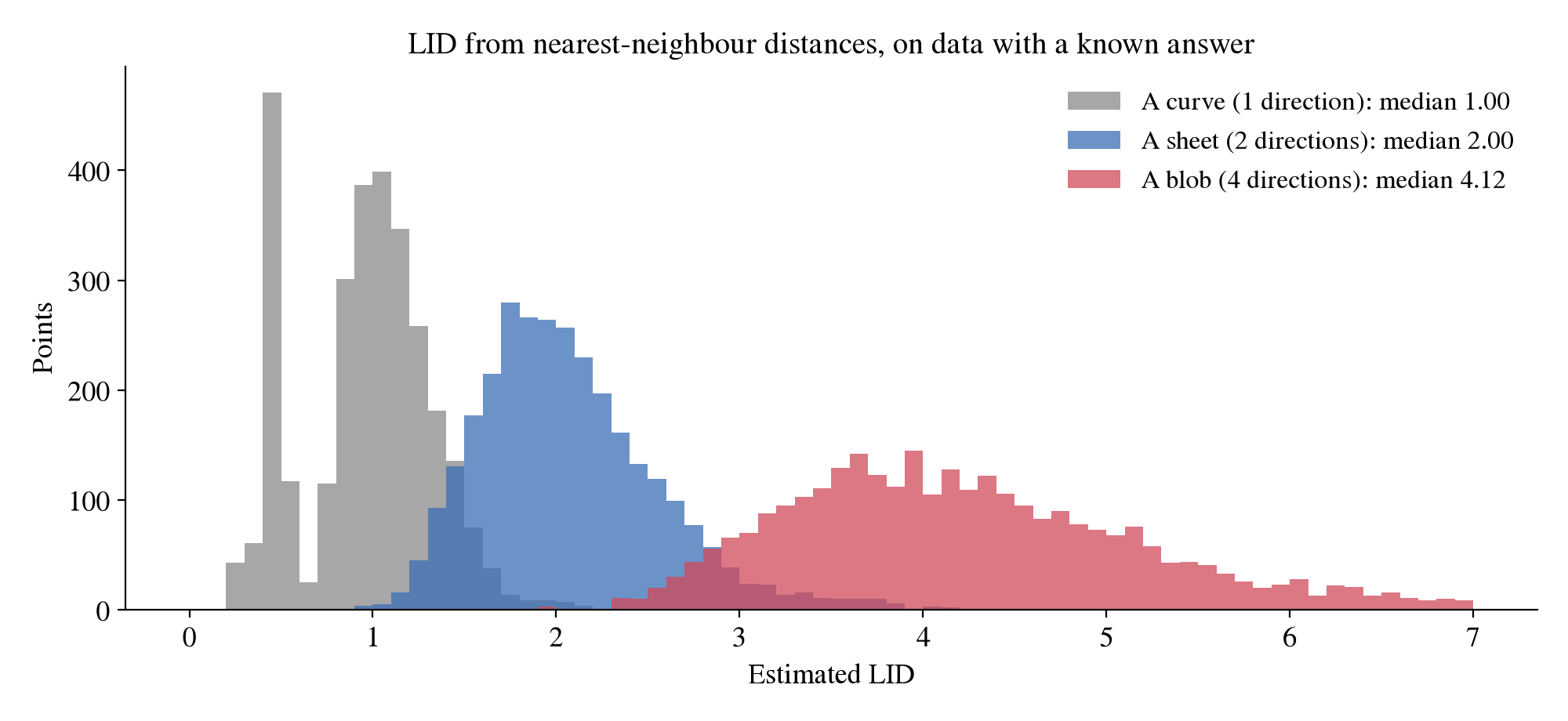
The LID estimator on data with a known answer: points on a curve, a sheet and a blob in 10 dimensions come out near 1, 2 and 4.
Results
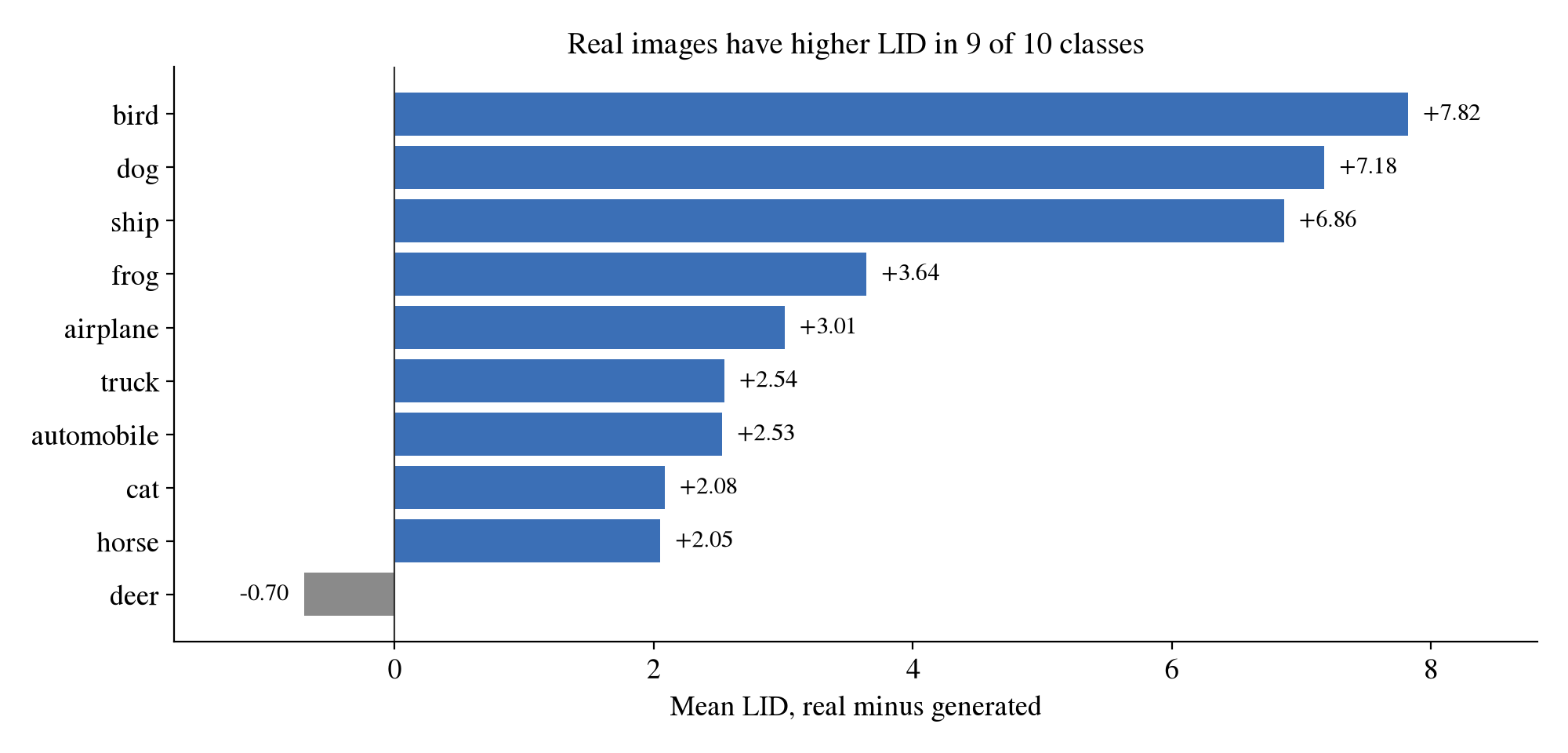
How much higher the mean LID of real images is in each class. Deer is the only class where generated images come out higher.
| 100,000 Analyzed real and AI-generated images, half of each, through a ResNet-18. |
| 36.18 vs 32.48 Measured a higher mean LID for real images than for generated ones. |
| 9 of 10 Found real images higher in every class except deer. |
| 61.5% Reached this held-out accuracy with a single LID threshold, k = 640 and the cutoff picked on a training split. |
| 88.8% Compared with logistic regression on the full features, for reference. |