
Video to Texels: Animated 3D Pixel Art from Video
From September to October 2026 I worked on video-to-texels, a differentiable texels method to make meshless 3D pixel characters and animations from video. It grew out of my DMesh++ research. Above is a small demo with a plush prince, where the stars and light trails are their own layers 🙂
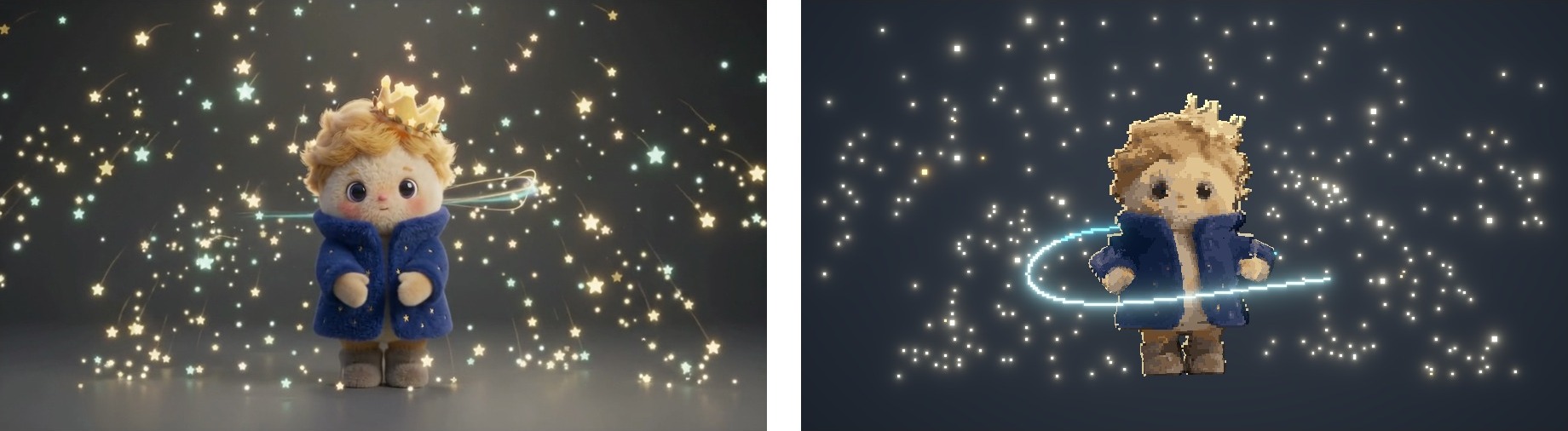
The plush prince. Left: a frame of the input video. Right: the same frame rebuilt from texels.
Problem
Pixel art in 3D usually breaks as soon as the camera moves: the pixels slide across the character and shimmer. Building and animating a 3D character by hand also takes a lot of time. I wanted a model that keeps its pixels fixed on the character from any angle, and that gets its shape, colour and motion straight from video.
How it works
The character is built from texels, small cubes with one palette colour each. The nearest texel owns each screen pixel, so the pixels stay put as the camera orbits. The model is built in layers that can be switched on and off:
- Shape: the turnaround video gives a mask and a camera for each frame, and the cubes are fitted to all views at once with differentiable ray marching.
- Colour: each view votes on a palette colour for every texel, and views that disagree count less.
- Motion: a hand-placed skeleton is fitted to every frame of the performance using about 3,000 tracked surface points, and each texel follows its nearest bones.
- Light and sound: stars, dust and trails from the video become their own texel layers, played with the original audio.
Results
I tested the pipeline on two characters, a plush prince and a green wolf. Both play back as 3D pixel art that can be orbited and zoomed while they move.
| 2 Rebuilt characters from video, a plush prince and a green wolf. |
| ~15 min Measured each character from its two videos. |
| ~4 min Built each 3D pixel art model. |
| ~3,000 Tracked surface points to fit the skeleton to every frame. |
There are still limits: depth from a single camera is a guess, the video’s lighting is baked into the colours, and short limbs cannot wrap fully around a wide body.
The stable pixel look was inspired by Dylan Ebert’s Texel Splatting. The pipeline uses CoTracker3 for point tracking and COLMAP for camera poses.